maysw

Blast. Textiles. Art. Travel. Tribes. Textiles. Blast
Showing posts with label bac ha. Show all posts

Thursday, November 8, 2012

Flower Hmong II - defined versions (they got the blues)


.Flower . flora. fleur. fiore. flor. blume. bloem. hoa. 花. ดอกไม้. फूल. زهرة.


Right! In a previous post I talked of the Flower Hmong - the colourful type typically found in Bac Ha area of the Lao Cai province. They were indeed a colourful, albeit - multicoloured bunch.


.Defining. Types.

Of each group, there will be a sub-group within a sub-group. So we have the Hmong which consist of the Flower Hmong...but then there are variations of these Flower Hmong - and I have probably not seen a fraction of them. Wow.

Here, in these locations headed below, these types of Flower Hmong were found...


>Muong Hum
Muong Hum market once again, these blue ladies were fetching in their sky blue, white and green colours, combined together with silver coins and green beading. Again, they have the very asian style of a wrap over asymmetric top, sometimes arm bands and headscarves, cropped bags, aprons and infamous eye-catching puffy crinkly skirts!

The men of this hill tribe also seem to wear the trendy slick styles too. Cropped top/jackets are definitely way to go, together with high waisted flared trousers. Sleeves, borders and hems of clothing (top half especially)are embellished with decorative features.


>On the road + SaPa
Found these treasures on a weekend day in SaPa and whilst on the road (on motorbike) in the Lao Cai province. I didn't stop to capture them for the latter, though in SaPa, eye-spied their pretty hairstyles from afar in the main square. They had travelled into SaPa to sell their old clothes and textiles; fairly similar to a jumble sale! It's clear that their outfit colours are similar to the other Muong Hum Flower Hmong (blending in with nature colours) - with a differing head dress/style...interesting. It's an art.

What a technique! Buns, ribbons, silver clips, silver comb = a Star Wars style. How did they think of such a style? Adaptions from nature/flora and fauna, perhaps?


Beauties of the nature,
Wowzers x

Thursday, August 30, 2012

The Flower Hmong


Introducing another type of Hmong!
I shall try my best-est to keep this shorter than previous hill tribe posts. And believe me, there will definitely not just be one post about this type'ov Hmong. You will see why...


All tribes are so beautiful in their own unique way, though the Flower Hmong steal the show due to their very eye catching outfits that present an extreme amount of colours that promenade the Vietnamese mountains

This tribe is mainly prevalent in the north eastern area - largely Bắc Hà of the Lào Cai and around. This tribe generally come out to play on their market days. Keep an eye out! .


Costumes: Focusing on the women (since the women are usually the ones that steal the show!), they are highly distinguished ornate in their colourful overflowing gowns. Their outfits are made up of the following:

. Headscarf or Head Ornament - be it colourful of any kind. Though this is usually weather dependent.. i.e. when it's chilly! Ornaments can be beaded.

. Shoulder Cloaks - As they wrap around the neck, they are buttoned with 'Chinese styled buttons' in an asymmetric Chinese manner. Decorative, hand stitched (with a machine, perhaps) and exceptionally colourful. These cloaks may also be attached to a colourful long-sleeved top worn below the cloak. Colourful and intricate beading may also be added to the bottom ends of the cloak or within the fabric.

. Arm Warmers - Usually developed from the same material and patterns as the Shoulder Cloak, these are used for decorative purposes and to keep warm. These may also be attached to the long-sleeved top in their stripy horizontal style.

. Skirt - The infamous Flower Hmong Skirt! Traditional skirts are hand stitched in the same fabric as the Shoulder lock and Arm Warmers. The fabric is heavy, wide and is gathered in multiple layers - which offers a puffed and generous look, along with its intricate colours stitched in a horizontal style. New styled skirts, which are lighter are printed using batik printing.

. Apron - A waist apron is worn, again, in the heavy weighted fabric, this time, with a vertical stripy pattern to contrast the horizontal skirt lines. This may assist with warmth, to wash hands and generally for decorative purposes. It is tied up at the back of the lady.


. Leg Warmers - Again, the same material might be used and the horizontal pattern is used.

. Shoes- Shoes are the obvious plastic sandals, frequently imported from neighbouring China. Used for trekking, rice paddy fielding, farming....everything a Flower Hmong can do!

. Baby Carrier- These are very popular and are usually a customised form of the apron. The stripes are to be vertical and colourful!


Colours The key word here is bright. It's important to use bright attentive colours, such as reds, pinks, oranges, purples, blues.. with traces of lighter colours - green, yellow, greens... beauty! A reminder that this only apples to the women.


That's all for the Flower Hmongs. They are absolutely wonderful. The photos will aid this post more than the text I reckon! See next posts for more information. Thanks x

Tuesday, July 24, 2012

The Black Hmong


Historic Hmong Snippet: The Hmongs are the most popular ethnic minority within the Indo-China region (Thai, Laos, Cambodia, Vietnam). Like the Dao people (see previous post), the Hmong people originated from southern China, but once again, due to the struggles against feudalist China, they emigrated to the areas of northern Vietnam. This occurred in the 19th century and it is here they began to build hamlets in the regions of Lao Cai and Ha Giang (the northern-most regions of Vietnam).

As the Hmong people ventured out to various regions, they began to develop and differentiate themselves from one another and thus, built various sub-groups. A common language (Hmong) albeit different dialects is spoken, culturally very similar, but a large visual difference - and that is, again, their textiles and dress. Note: These sub-groups don't seem to have any disputes with one another and seem to get along, just fine! ;)


Discovering & exploring: Being highly captivated by these various dress styles and detail, I managed to find various tribes in the region. Focusing on the Hmong people, I discovered a couple of them, but sure I'll focus on them one by one. It's here I give you...


The Black Hmong. Ah, the famous Black Hmong. I've mentioned this hill tribe in a previous post http://maysanw.blogspot.co.uk/2012/05/hmong-robots.html. Yep, they continue to pester and sell their clothing and accessories, but this is clearly their livelihood.


Textiles: "It is believed that whether their houses are beautiful and of good quality depends on the husbands, and whether they are wearing beautiful clothes and their children are taken care of or not depends upon the wives". Thus, the women must hone good embroidery skills to present their skilfulness and ability to work hard. In addition, handmaking their cloth from scratch - using the hemp they grow in their beautiful rice-terraced fields and hand-dyeing using indigo plants grown amongst the hemp.

Their colour is distinct and although is stated as 'black', it tends to be more of a dark, dark indigo colour - hence, being grown from indigo plants. Hand and natural dyeing is a tradition, however, it seems that due to tourism, the Hmongs know too well that chemical dyeing and buying cloth from the market (imported from China usually) is a speedier way of creating these profitable textiled products! This seems to have made its mark in the product market. But behold! Tradition still stands - as below indicates...Yet again, women are responsible for the dyeing process.


Traditional fabric: Fabric is made from the strong and resisting fibre; Hemp. The hemp plant surrounds the Hmong villages and is often grown in March of the lunar calender and due to its speedy growth - is harvested after two months.


Once harvested, the following takes place....

.The hemp is air-dried and peeled into threads.
.The threads are then ground in a mortar.
.They are then are then hung on beams within their homes and flattened.
.Two or three days later, they are rolled into big rolls, then eventually spun.
.The hemp is then boiled and spun into rolls of thread by a reel. [1kg of hemp threads can take two or three days].
.Hemp threads are joined and spun into threads. [Women learn at the tender age of 6 or 7 years old to spin the hemp - and learnt either by their mothers, grandmothers, sisters, or self-taught!]
.To strain hemp threads into longer ones, the spun hemp threads are boiled with wax many times.
.Once removed from the liquid, they are flattened by a stone or a piece of wood, and air-dried until the yarns are shiny and smooth.
.The yarn is then spun onto a large reel (khau li ) to make longer yarns which are then stretched on the loom. [This type of process is only performed on sunny days to prevent tangling of yarns].


Weaving: Most women are apt on weaving. Not all families will own a loom. Those without a loom, are to rent a loom or weaver.


Tailoring clothes: The women are also skilled to tailor clothing and traditionally stick by the lunar calender. Therefore, dresses and trousers are made in September or November at the latest, in time for the Tet holiday (new year).

Once woven...


How the Black Hmong become 'black'
Welllll...not quite black. Indigo!
Indigo plants are the instigator for the black coloured clothing. Indigo plant seeds are often planted in April or May and harvested in June. The Hmong follow an auspicious calendar, that said, the indigo must be planted at the beginning of the month i.e. the lucky days, to avoid worms and diseases that may come about if planted at the end of the month. In addition, the indigo must be harvested at the correct time. Failing to do so may lead to, weak older leaves and the resin will not be good as expected.


From plant - to resin - to dye Once the indigo is cut, it is soaked in water for 2-3 days. As soon as the water turns black, dissolved powdered lime is mixed and stirred in for thirty minutes which turns the water into a shiny black. After three hours, indigo resin condenses to the bottom of the bucket. This is put into a pack and filtered into a dry resin.

The resin is then mixed with water in wooden or plastic buckets and sediments are then filtered. Once again, this may take place on auspicious days - specific days may be chosen, such as days of tigers, buffaloes, dragons, chickens or horses, instead of days of pigs.


Hmong tradition also suggests that pregnant women are not to touch the buckets of indigo resin as they will cause the indigo to die (note: alive buckets of indigo will form a foam). When mixing the indigo, men are not allowed to stay in the house, except the woman's husband.


Indigo dyeing
Yet again, women are responsible for the dyeing process. When dyeing the fabric, the indigo must be consistently stirred. If there is no trace of foam (i.e. indigo has died), the process must be restarted. After each dyeing stage which can take 30 minutes, the cloth is air-dried and is continued another twenty times or so, or at least until the Hmongs are content. They may press their fingers onto the surface of the cloth. If no white gaps are present, this means that the piece of cloth has been beautifully dyed.


Embroidery Like the Red Daos, the Black Hmong also enjoy embroidering and believe that all women should be involved and know how to embroider to show skilfulness and ability. Different patterns are embroidered on Hmong peoples' clothing.

- Spiral patterns are common on belts, collars of female clothing. Patterns on belts are larger than those on collars.

- Pumpkin flower patterns are common on collars of male clothing. Male costume patterns are usually smaller.

- Patterns on sleeves are created on female clothing. The patterns are often smaller and different patterns are created such as dragons, stars and more recently, hearts.


Wax patterns In Hmong history, Hmong people who went into the forest to collect honey came across forests of indigo. They found that wax would stick to their clothing and indigo would dye their clothing. As they peeled away the wax, the original white coloured hemp was left on those areas of the cloth. This was considered to be beautiful. Hmong people would thank the bees for this discovery which leads to another style, and process..Wax patterns. Wax drawings are drawn onto the un-dyed hemp cloth. A paintbrush is immersed into the melted wax and is then used to draw onto the fabric. Numerous brushes are used to draw different patterns. Since bees were the path to their discovery, they are popularly featured on the clothing patterns.


Other decorative features...


Earrings Hmong girls adorned with large hooped metal earrings also signify that this girl is married. The earrings are traditionally made by their husbands where they will batter and emboss the metal. Intricate and detailed, heavy and jingly. Other jewellery is worn for decoration, such as heavy necklaces and bracelets.


Hats Round black hollow hats are again not compulsory in the costume but for extra decoration, and to veer off the cold conditions that the Hmongs experience through winter months. They tend to be more popular amongst the older female population.


Hairstyles Girls leave their hair growing long , extremely healthy looking. Once the girl has married, she will tie her hair in an intricate manner, as shown below.

Note: As the girls do not wash their hair too often, it becomes oilier, thus the natural oils help maintain the married Hmong girl's hairstyle and shape.


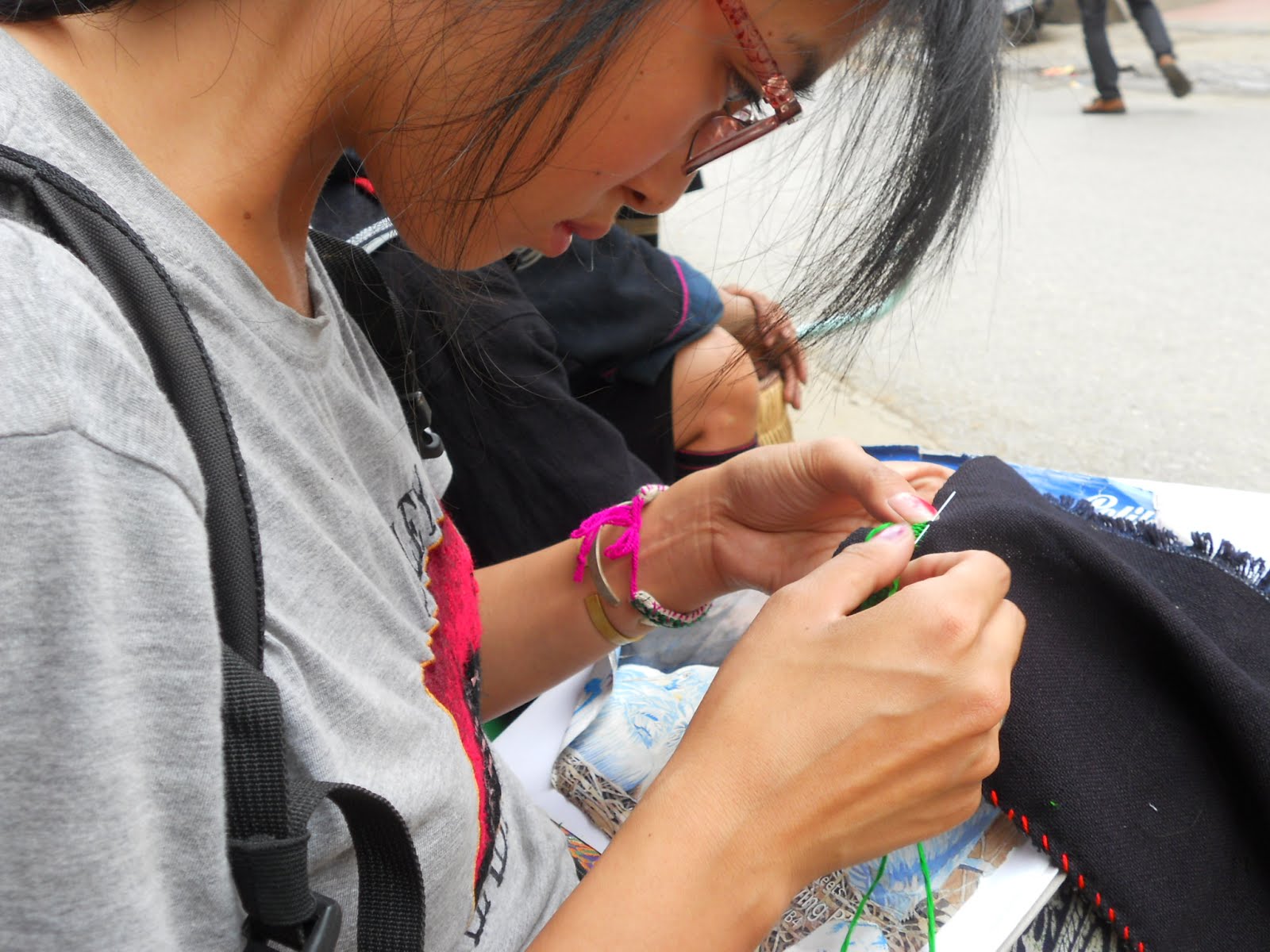
Discovered So, that was a small summary of the beautiful Black Hmong. Their mountain beauty is projected well through their costumes. I very much enjoyed integrating and finding out the information. See below for my experience with embroidery on the 3 step patterns - it was not easy, and I'm definitely not up to their speed!


Wednesday, June 20, 2012

Red Dao people


It seems that most of the tribes of this northern region of Vietnam are presented in an ornate and decorative manner. From tribe to tribe, they are boldly differentiated, largely by the use of style and colour. I came to the region to find out why..

There is clearly a reason as to why these tribes still dress as they do. It seemed to me to be quite a ridiculed way of living in the mountains - dressed in funny, strange and impractical costumes. But with these tribes, clothing is stemmed from nature and producing them is a livelihood. Their 'uniform' is one of the key visual differentiators between groups [that still being a valid way in modern day western living]. Though it may seem shallow as a shallow end of a swimming pool can be...but, it surely is true, that - how you dress; is sense of identification, belonging and ultimately expresses and partly conjures who you are.


The Daos

A little history: Dating back, history finding their origins in the southern west parts of China. The Daos migrated to Vietnam around the start of the 12th or 13th century and continued until the early 20th century. Drought, failed farming of crops and Feudalism pressures in China promoted this migration during the Minh dynasty. Whilst in China, the Dao were divided into smaller groups - still with common language, though perhaps slight different cultural techniques and different visual costumes. It was here that....


The Red Dao migrated to the hills of Vietnam. The Red Dao are one main group of the Dao people and mostly found in and around the SaPa (tourist mecca) region of Vietnam - mainly emanating from the village of TaPhin. You cannot visit SaPa without witnessing the sight of their beautifully and intricately designed clothing.


Textiles
As mentioned above, I would like to reinforce that The Red Dao are very intricately styled. The daily female costumes are shown below:


Women attire: The married women tend to wear the red scarves on their heads and hand-embroidered aprons. I'm guessing red was chosen to represent strength and for ease of identifying amongst the green mountains. I'm sure there's more reason to it, but the differing head ornaments are worn according to the weather climate! i.e. heavier for the winter periods. The jacket is meticulously embroidered as are the short and wide trousers.


Headscarves:


Bodywear:


Hats: Small boys will traditionally wear hats and short shirts made by their mother or sister(s). Boys will wear red and black hats with fringes and beads , whilst girls will wear hats of three colours - black, yellow, white - with embroidered patterns and silk.


Embroidery:
Embroidery is absolutely important in Dao families. It is the female's job in the family to produce clothing and decorate their tribal patterns. Girls are encouraged to learn at a young age (as young as 6 or 7). Failure to learn means they're clothing will not be beautiful enough and they 'will be left off the shelf'. Thus, nobody will marry them...eek! *Hurry up, girls. Get learning!* Before being trained to embroider, girls must be trained by mothers and grandmas meticulously on how to count threads i.e. two-thread and three-thread patterns, and how to embroider in a straight line in an up & down technique. They embroider on the reverse side of the cloth. The embroider forms beautiful designs of the images below. Embroidering is not done overnight. No way. There is quality involved here. A jacket's embroidery can take months and months to be completed. Small stitches and very, very intricate detail. Whilst time is irrelevant, quality is not!

Numerous images are created, some being; animals, weather (thunder), nature (flowers, trees)...etc. The embroidered pattern will portray various meanings, such as, representing the village where they are from, luck and fortune, happiness, power, strength, promoting crop growth (i.e. worms and snails), to tell stories of the moment.


A summary of cloth & serious dyeing talk:
Unlike other neighbouring tribes, the Daos do not plant hemp and do the weaving. Traditional villages will buy the cloth, dye it and design and tailor the clothes themselves. In most instances, naturally extracted dye is used and the following colours are created using the relative natural components:

.Yellow - fibraurea tinctoria Lour roots
.Red - sam mua wood
.Brown - dioscorea cirrhosa Lour roots

When using 'dioscorea cirrhosa Lour roots', the old roots are peeled sliced and then put into a clean pot to be boiled until the liquid becomes a dark brown colour. The cloth is to remain unpressed and lowered gradually into the dying liquid to soak for 2-3 minutes and is then this cloth is air-dried. Once the cloth is dry, the same is done to the other side to ensure that both sides are of the same colour.

Silk dying uses 'Fibraurea tinctoria Lour roots' - which are chopped and boiled. When highly condensed, the liquid is poured into a basin and is repeated 2-3 times.


So, there you go. That was a little insight into the Red Dao and their meticulously designed clothing that is worn on a daily basis. It seems impractical but it represents who they are, culture and traditions. I highly rate them, especially having seen first-hand how much time and effort is mounted to produce such clothing. Pure quality. There's more to it than meets the eye.